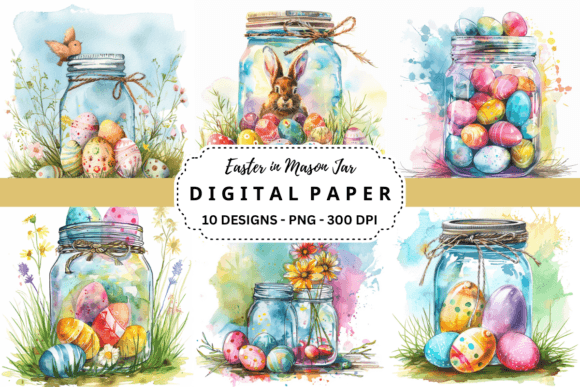
Easter in Mason Jar Backgrounds: A Designer's Spring Toolkit
When a client asks for something that feels "springy, textured, and a bit rustic," I often find myself reaching for design assets that bridge the gap between digital precision and handcrafted charm. This is precisely the niche filled by Easter in Mason Jar Backgrounds. It’s a collection that doesn't just depict Easter; it evokes the feeling of a sunlit afternoon spent dyeing eggs or arranging flowers in a vintage jar. The visual personality here is one of soft focus and layered texture. Think of the subtle, milky transparency of glass, the delicate weave of a burlap ribbon, and the vibrant but slightly muted pastels of dyed eggs and spring blooms. It’s a style that feels both nostalgic and clean, avoiding the overwhelming clutter of some holiday graphics. The appeal lies in its versatility; it provides a rich, complete scene that can stand on its own or serve as a foundational layer for more complex designs.
Where This Collection Truly Shines
The real-world applications for these backgrounds are surprisingly extensive, moving far beyond simple greeting cards. For social media managers, these are gold. Imagine an Instagram grid for a boutique bakery, a florist, or a lifestyle brand during the spring season. Using a consistent background from this set—perhaps the one with soft pink peonies and speckled eggs—creates an immediate visual theme. Overlay your product shot, a promotional text, or a customer testimonial, and you have a cohesive, professional-looking post in minutes. This consistency is key for brand recognition. Your audience starts to associate that specific visual palette with your brand's spring identity, building familiarity without a single word of copy.
For entrepreneurs and small business owners, especially those in print-on-demand or e-commerce, the utility multiplies. These aren't just backgrounds; they are design components. A podcaster could use them as episode artwork for a spring-themed series. A wedding planner could integrate them into digital invitations or table number designs, printing them on high-quality cardstock for a tactile feel. The 300 DPI and 3600x3600 pixel dimensions are critical here—they ensure your designs remain crisp whether you're printing a small label for artisanal jam or scaling up for a market banner. The quality holds, which directly impacts how professional your final product feels to a customer.
Integrating Textures with Modern Typography
Here’s where many creators get stuck: how do you pair a detailed, photographic background with text without it becoming a jumbled mess? The secret is contrast and hierarchy. Easter in Mason Jar Backgrounds provides the texture; your typography must provide the clarity. This is where understanding font pairing becomes essential. A bold, clean sans-serif font like Montserrat or Futura often works beautifully. Its geometric simplicity and strong lines cut through the soft, organic textures of the background, ensuring your message is legible at a glance. For a headline or a brand name, you might consider a premium font with a bit more character—a modern serif with sharp details or a clean, non-flowing script font—to add a touch of elegance without sacrificing readability.
Consider the context. If you're designing a social media graphic for a 24-hour flash sale, legibility is paramount. Use a strong, dark-colored sans-serif placed over a slightly lighter or less detailed area of the masonry jar image. You can often use a subtle color overlay or a soft drop shadow to create a "safe zone" for your text. For a wedding invitation, however, the goal shifts toward atmosphere. Here, a delicate script font in a complementary color—perhaps a dusty rose or sage green pulled from the eggs in the scene—can float elegantly, with the background acting more as a textured canvas than a competing element. Always test your designs on a phone screen; if you can't read the text easily while scrolling, simplify.
A Practical Guide to Using These Assets
Before diving into a project, take a moment to evaluate the specific backgrounds in the collection. Lay them all out. Do you need a scene with a dominant color, like a soft blue, to match a client's brand palette? Or does a more neutral, multi-colored composition offer more flexibility? Think about the negative space within each image. A background where the mason jar is off to one side leaves a large area of relatively clear texture perfect for placing a logo or a block of text. A more centered, busy composition might work better as a full-bleed background for a poster where text is minimal.
For those using these for commercial projects—like selling printed invitations or creating templates for resale—always double-check the licensing terms of the specific product you purchase. Most reputable design asset providers offer clear commercial use licenses, but it's a professional courtesy to your own business to verify. When testing font pairings, create a simple style guide. Choose one primary font for headlines, one for body text, and maybe one accent font. Stick to these throughout your project to maintain brand consistency. For example, pair the background with "Playfair Display" for headings and "Open Sans" for body copy. This disciplined approach prevents your design from looking disjointed and reinforces a sense of intentional, professional branding.
Ultimately, collections like Easter in Mason Jar Backgrounds are about providing a strong creative starting point. They handle the heavy lifting of creating a mood and a seasonal context, freeing you up to focus on the core message of your project. Whether you're a crafter making personalized gifts, a marketer building a spring campaign, or a designer developing a full brand identity for a client, having a set of high-quality, thematically cohesive design assets in your toolkit is not a luxury—it's a practical necessity for efficient, high-quality output. It allows you to deliver that polished, "I spent hours on this" feel without actually spending hours sourcing and composing the background from scratch.